by Brian Roulston
Lighthouses have stood as beacons of hope for sailors and early aviators navigating oceans, lakes, and rugged coastlines. These towers—sometimes elegant, sometimes stubbornly plain—were built for one purpose: to keep people alive. On the Great Lakes, where storms rise fast and visibility can vanish in minutes, lighthouses were often the only thing standing between a ship and disaster. The Burlington Canal Lighthouse was one of these quiet heroes.
Long before GPS or radar, sailors relied on tools like the sextant and astrolabe to navigate open water. The instruments helped them measure the height of the sun or stars to determine their position. But once they neared land, celestial navigation wasn’t enough. Coastlines hid rocks, shoals, and sandbars that could tear a ship apart. At night, everything became even more treacherous. Lighthouses filled that gap—bright, dependable, and visible from miles away. They were the last guidepost before safety.
From Ancient Fires to Modern Lights The earliest lighthouses were simple bonfires lit on cliffs. The most famous early example of a lighthouse was the Pharos of Alexandria, built around 280 BCE. Roughly 120 metres tall it could be seen nearly 60 kilometres out to sea. For centuries, this was the gold standard. The Romans later built their own network of stone towers to guide merchant ships. Some still stand today. But after the fall of the Roman Empire, lighthouse construction slowed for centuries until trade revived in the 18th century and new technology sparked a renaissance in lighthouse design.
Lighting the Way Before electricity, lighthouse keepers relied on whale oil to fuel their lamps. It burned brightly and steadily, but the growing concern over whale populations pushed keepers to switch to lard oil for a time. Eventually, kerosene became the preferred fuel—cleaner, brighter, and easier to manage. Later came vaporized oil lamps, and finally electricity, which transformed lighthouse lighting forever. Early lighthouses used mirrors and reflectors, but much of the light was lost. That changed in 1822 when French engineer Augustin-Jean Fresnel invented a new type of lens made of carefully cut glass rings and prisms. This Fresnel lens captured nearly all the light from a lamp and focused it into a powerful beam that could reach astonishing distances. But the invention had a hidden danger. To help the massive lens rotate smoothly, it was often floated on a pool of mercury. The vapors were toxic. Many cases of “Lighthouse Keeper’s Madness,” once blamed on isolation, were likely caused by mercury poisoning.
The Life of a Lighthouse Keeper Despite the technology, it was the keeper who made the lighthouse work. The job was demanding, lonely, and often dangerous. Rogue waves could smash into the tower, sometimes destroying them. Ice storms coated ladders and railings. A missed step or a moment of carelessness could be fatal. In Canada and the United States, lighthouse keeper positions were often political appointments and many had no maritime background – farmers, carpenters, or even lawyers—anyone reliable, sober, and steady. A failure to tend the light could mean a shipwreck, so expectations were strict; daily trimming wicks, refilling fuel, cleaning soot from the lens, and winding the heavy clockwork that rotated the light. In fog, keepers had to activate the foghorn, sometimes by hand. As technology advanced, they also relayed weather reports and distress calls using Morse code and later radio. Lighthouse keeping often became a family tradition. Keepers passed the role down through generations, and women played a significant part in this history. When a keeper died, his wife or daughter often took over, already familiar with the routines and responsibilities.
Canada’s Lighthouse Story Canada’s vast coastlines and inland waterways made lighthouses essential. The first Canadian lighthouse was in Louisbourg, Nova Scotia, in 1734. After Confederation, Canada expanded its network, including the impressive Imperial Towers on Lake Huron. These stone towers were built by Scottish mason John Brown, who also constructed the Burlington Canal Lighthouse.
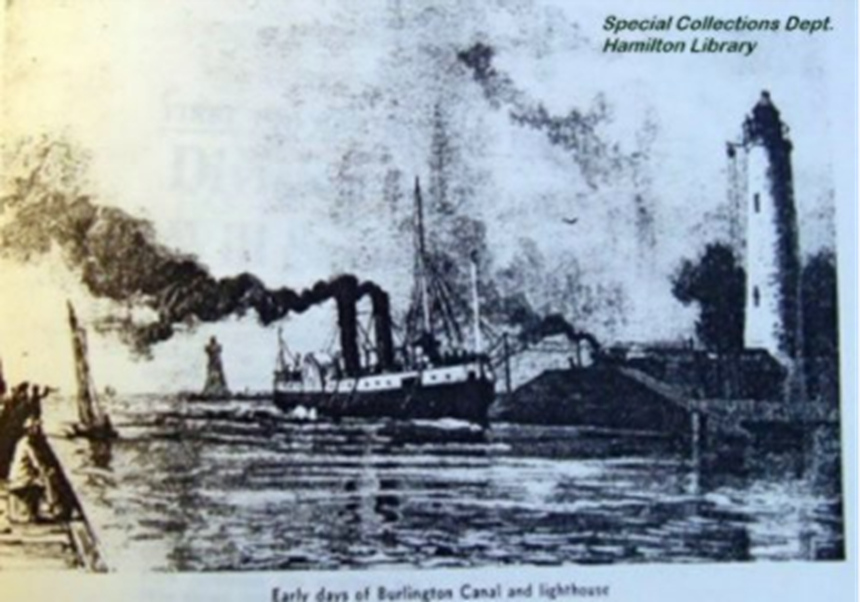
The Burlington Canal Lighthouses When the Burlington Canal was dredged a second time and reopened in 1832, two small lights marked the entrance. but the shoreline stayed dangerously dark at night. According to local legend, “wreckers” sometimes set up fake lights along the beach to lure ships aground and steal their cargo. A new lighthouse, a five‑story, octagonal wooden tower was constructed by American John L. Williams. George Thompson, the keeper of the lighthouse, was responsible for more than just the light. Strong currents scraped ships against the wooden piers, and sparks from steamships often set the piers on fire. Thompson and the ferryman sometimes had to rip off burning planks with their bare hands and throw them into the canal. A fire in 1856, started by a spark from the steamship Ranger, destroyed the wooden lighthouse and keeper’s house. The current lighthouse, a tall, round limestone tower 90 feet high with seven‑foot‑thick walls, was built in 1875 for $10,479.98, a huge sum at the time.
George Thompson: The First Keeper George Thompson, a retired sailing master, became the first keeper of the current lighthouse in 1858. He served until 1875, and his diaries, kept at the Joseph Brant Museum. offer a rare look into his life. He earned $75 every three months. The Burlington Canal Lighthouse was one of the first in Canada to switch from whale oil to coal oil. Coal oil freezes easily. Thompson wrapped the lamps in flannel and rope yarn, yet the oil still sometimes froze solid.
The Last Keeper As technology improved, the role of the keeper slowly faded. By the late twentieth century, the last man to see the job through was Peter Coletti until automation in 1987. Locals remembered him as a colourful character with a “pirate aura.” He had never worked at sea, but he was a self‑taught handyman who found his calling later in life. His two parrots—Foghorn and Gasbag—became part of his legend. Even after the lighthouse was decommissioned in 1961, Coletti continued tending the canal’s lights and bridges. Through the 1970s and 1980s, he remained a familiar presence on the pier. He was the last person to live in the keeper’s cottage before it was vacated in 1991. Later, he worked at lighthouses on Lake Erie and in New Brunswick, before retiring to spend his days enjoying life on his small fishing boat.
Navigation Today Modern ships still pay attention to lighthouses, but they no longer rely on them the way they once did. Today, most navigation happens through electronic systems that show a ship’s exact position, speed, and surroundings in real time. GPS provides constant location updates, and radar helps crews “see” other vessels and obstacles even in fog or darkness. Electronic charts have replaced paper maps, and they warn captains automatically if they drift too close to shallow water or a restricted area. Many harbours, including Hamilton, also use automated beacons, sensors, and traffic‑control systems. They work a bit like the guidance systems you’d see at a busy airport, directing traffic and keeping everyone in their proper lanes no matter the weather or visibility. These signals go straight to the ships and help coordinate safe movement through narrow channels.
The old lights still shine, their glow softened by time, now part of a broader network that keeps ships on course. They stand as reminders of the days when a single keeper’s hand made all the difference.
A New Role for the Burlington Canal Lighthouse
Today, the Burlington Canal Lighthouse is a protected heritage site. Though no longer an active aid to navigation, plans are underway to move and restore the lighthouse and its cottage. The goal is to create a public space that preserves this important landmark and honours the people who kept its light burning. Lighthouses may no longer guide ships the way they once did, but their stories—of danger, duty, and determination—continue to shine.