 By Prof. Rowr (AKA Brian Roulston)
As winter fades, snow melts, waterfalls roar and the trees stretch out their first bright green leaves. And while all this is happening above, something amazing is starting deep down in Lake Ontario—a secret spring surprise getting ready to flip the whole lake awake! Rowr!
The Science of the Flip: Unveiling Nature’s Grand Design! In its simplest explanation, to truly grasp this colossal event, you first must picture the lake in late winter. Even though the sky’s been gloomy and the air was freezing the lake isn’t uniformly cold. It’s layered, a state known as “winter stratification” or “Inverse Stratification”. Rowr! Sounds fancy, doesn’t it, my little scientists?
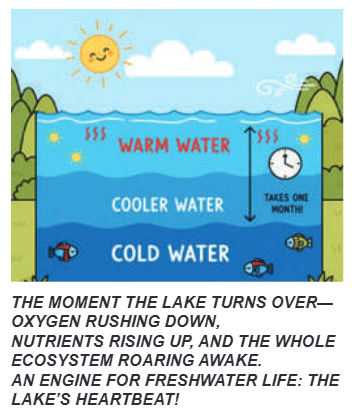 At 4℃, this life-giving water settles to the very bottom. Above it is colder, less dense water, topped with an icy blanket near 0℃. The winter lake is motionless and divided. Aquatic life deep in the lake slowly depletes trapped oxygen while precious nutrients (food) from decaying matter accumulates on the lakebed, just waiting for their moment.
As April triumphs over winter, the sun’s stronger rays and warmer air begin to trigger the flip. Surface ice melts away, and the top layer of water slowly warms toward 4°C. As it reaches that magical number, the water becomes heavier a nd sinks. This oxygen‑rich surface water plunges toward the lakebed, pushing the deep, nutrient‑rich water upward in a spectacular exchange.
Powerful spring winds sweep across the lake and speed up the process, stirring the water like a giant pot of soup until the entire lake is completely mixed.
The moment the lake turns over—oxygen rushing down,
nutrients rising up, and the whole ecosystem roaring awake.
An Engine for Freshwater Life: The Lake’s Heartbeat!
This process isn’t just important—it’s vital for lake life! Without it, a deep lake like Ontario or the other Great Lakes would be largely lifeless, a watery wasteland.
A Deep Breath for the Lake! Most aquatic animals— like trout and salmon, and even frogs—need oxygen to survive. In winter the deep water is sealed off from the air above, and its oxygen supply slowly and dangerously runs low. Turnover brings a huge rush of oxygen‑rich water from the surface down to the depths. It refreshes the deep zone and stops it from becoming a “dead zone” where nothing can live. The lake is taking a giant, rejuvenating breath! Rowr! And that’s no small roar, my friends!
Fueling the Entire Food Web: A Feast for All! Turnover also acts like a gigantic, unstoppable elevator for nutrients. It lifts phosphorus and nitrogen from the lake bottom and carries them up into the sunlit surface waters. This sudden burst of natural fertilizer sparks a huge bloom of phytoplankton—tiny, plant‑like algae. This “spring bloom” is the most important event of the year, because it creates the base of the entire food web. The phytoplankton feed zooplankton—tiny drifting animals such as water fleas and copepods, little shrimp‑like specks—which are eaten by small fish who are in turn hunted by larger fish like salmon and trout. This single event supports the whole delicate underwater world. A true feast for freshwater life. Rowr! What a spectacular show of nature’s bounty, eh!
A Different Story in Hamilton Harbour: A Dynamic Dance! While the open lake experiences a predictable spring turnover, smaller bodies of water tell a different story. Ponds and harbours don’t behave the same way at all. Hamilton Harbour, being much shallower, acts in its own wild and lively way.
A strong April wind sweeps over the lake,
churning the water and blending oxygen and nutrients
the way a spoon stirs a hearty soup.
The shallow Harbour warms and cools much faster than the lake, and strong winds can mix its waters at almost any time of year. That makes it polymictic—a fancy word meaning it mixes many times, often unpredictably, instead of just twice a year. All that extra mixing means the Harbour can spark two, three, or even many more phytoplankton bloom each year.
The Harbour’s health is also shaped by nutrient runoff from Cootes Paradise and local creeks. These extra nutrients make mixing events even more important, because they help prevent dead zones from forming in the partially enclosed bay. It’s a constant, dynamic dance of stirring and renewal!
A Shorter Winter Coat for Our Lakes! Think of stratification as the time a lake wears its winter coat of ice. As climate change makes our world warmer, winters become milder and shorter. For a lake, this means it takes longer in the fall for the water to get cold enough to put on that ice coat. In spring, the air warms earlier and the ice melts much sooner. Because the lake puts its ice coat on later and takes it off earlier, the total time it spends layered up and frozen—the winter stratification period—shrinks. Fish and other creatures that rely on this rhythm of oxygen and nutrient changes may get confused or struggle to find enough food at the right time. Over time, this can disrupt the natural balance of the lake affecting which plants and animals thrive, leading to fewer of some species and more of others. It’s like changing the natural seasons for the lake, having big ripple effects on the entire underwater world.
From the deeps of the Great Lakes to the dynamic, ever‑changing waters of our harbour, this great spring flip is a powerful, unseen force. It truly awakens aquatic ecosystems, revealing the magnificent secret of our beloved Lake Ontario and Hamilton Bay. And that, my cubs, is the magnificent secret of our Great Lake!
And if your paws are still tingling with curiosity, my cubs, go explore! There’s so much more to discover about our lakes, our harbour, and the amazing world beneath the waves. Rowr! Learning is its own adventure.