by Brian Roulston
Image courtesy of the History & Archives Department, Hamilton Public Library
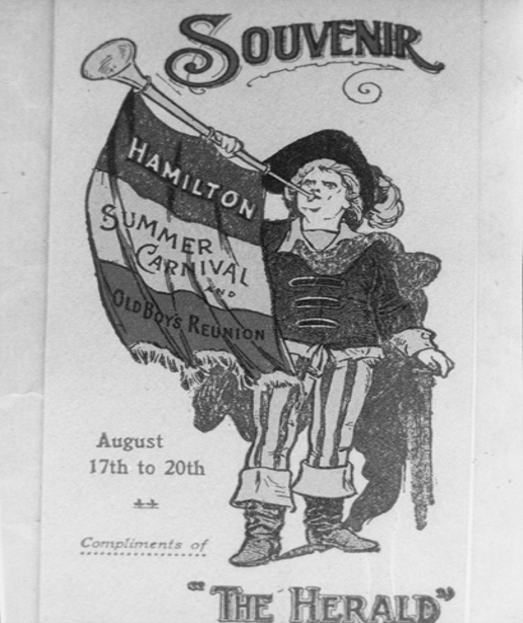
Hamilton woke up on Friday, August 21st, 1903 looking less like an industrial city and more like Mardi Gras had wandered onto King Street. The celebration had been building since the Old Boys began arriving the previous Friday — and by Sunday, the real rush had begun.
Tuesday — Old Boys’ Day: Two thousand Old Boys marched proudly through the streets, followed by the Veteran Firemen’s Parade — polished helmets, gleaming trumpets, restored wagons, and spectators ten deep. The Hamilton Times even claimed the parade included camels with ladies typing on typewriters strapped around their necks — a detail too strange to invent.
Wednesday — Citizens’ Day: The Floral Parade turned the streets into a moving garden of blossoms, ribbons, and bunting. Horses wore wreaths; children tossed petals; the air smelled of roses and pine. Later, Old Boys and Old Girls gathered at Central School for a reunion full of warm handshakes and tall tales.
Thursday — Civic Holiday and Military Day: Offices closed, factories slowed, and Hamilton focused on the grand military review. Soldiers from across Ontario, Buffalo, and Detroit marched in perfect unison — the defining spectacle of the week.
A City Flooded: Hamilton’s population of 52,000 suddenly swelled by another 44,000 visitors. Hotels, inns, and private homes overflowed. Some houses squeezed in as many as twenty guests. People slept in barns, garages, and train stations — anywhere they could stretch out. Rain had been predicted daily, but aside from a brief shower one evening, the weather cooperated. Residents decorated streets, hung lanterns, and prepared for the crowds. The City of Hamilton contributed $2,000 — a significant sum in 1903 — showing how seriously the celebration was taken. Naysayers had predicted a flop. Instead, even critics admitted the carnival was “gloriously successful.”
Empty Pews and a Transformed City: Sunday morning churches found their pews unexpectedly empty. By Monday, King Street was dressed like a parade float: evergreen arches, Japanese lanterns, bunting, flags, and electric lights glowing after sunset. Businesses decorated storefronts, residents hung banners, and even the streetcars gleamed. Hospitals joined in too, draped in huge flags. Former Hamiltonians returned from across Canada, the United States, England, Ireland, and beyond. So many horses arrived that the city’s livery stables overflowed, forcing parks and nearby streets to serve as temporary corrals.
The Rush Into Hamilton: Railway platforms at Stuart Street, Ferguson Avenue, and Hunter Street were jammed with arrivals. Regiments had to detrain quickly and march straight to the armoury to keep the platforms clear. Concerts and military displays greeted visitors. By Wednesday night, King Street was “jammed from building to building,” a solid river of flags, horns, and cheering crowds. Music filled the city. Eighteen thousand people gathered nightly at Dundurn Park, while smaller concerts played across town. Gore Park, glowing with lanterns and coloured lights, earned the nickname “Fairyland.”
The Trolley Driver’s Lament: No one felt the crush more than the Hamilton Street Railway conductors. One later said: “I’ve driven streetcars through snowstorms, football crowds, and election nights, but nothing compares to the 1903 Carnival. I had people on the roof, on the fenders, on the steps — hanging off the rails like laundry on wash day.” Forty‑eight cars ran nonstop, packed far beyond capacity.
The Military Spectacle: .Nearly 2,500 soldiers marched to the Old Hamilton Jockey Club Racetrack — now Centre Mall. The crowd, estimated between 12,000 and 15,000, was so dense the regiments could barely reach the infield. Feeding the visiting soldiers proved too much for local groups. A Toronto caterer stepped in — and the tough meat and slow service became the week’s main complaint among the troops.
Regatta, Lantern Boats, and the Carnival Market: Crowds lined the Burlington Beach strip for a sailboat regatta. Later that evening, illuminated “Lantern Boats” drifted through the Burlington Canal in a glowing parade. The Hamilton Market was so busy it could have been renamed the Carnival Market. Farmers’ wagons lined McNab Street, while the Midway squeezed in beside them, creating a lively jumble of wagons, barkers, music, and machinery.
Fireworks and the Fish‑Horn Finale: Each night, Hamilton Bay became a floating grandstand as hundreds of small boats — along with a few specially chartered steamers — gathered offshore. Crowds swelled along the shoreline as fireworks burst above Dundurn and Harvey Parks.Although no official events followed the final fireworks, the crowd wasn’t ready to go home. Up to fifty thousand people poured into the streets for one last blast. Thousands of rubber fish horns bleated in chaotic waves as confetti drifted like snow.
Remarkably Little Trouble: Despite the crowds, the week remained good‑natured. The Chief of Police reported that with only 40 officers, “everything passed off well.” Illegal gambling machines on the midway were shut down after complaints, but trouble was minimal.
Workhorses, Unions, and Trades: Hamilton was still very much a workhorse town, so the city and the SPCA staged a parade in the horses’ honour — decorated delivery horses and wagons from dairies, florists, meat packers, and coal companies. A scheduling mix-up merged the horse parade with the Union and Trades parade, creating a two‑hour procession that spectators loved.
The Great Cleanup and Legacy: After the carnival, Hamilton buzzed for weeks before slowly returning to normal. Decorations came down, shops reopened, and City Works crews swept up evergreen branches, rocket sticks, fish horns, and ash. For many visitors, the celebration left such a strong impression that former residents began thinking of returning home. The 1903 Summer Carnival became the benchmark for every celebration that followed — four days when Hamilton turned itself inside out with joy and for one unforgettable week in 1903, Hamilton didn’t just throw a party — it proved it could out-celebrate any city on the map.